Business Class at Economy Prices: 30-Day Examples
The question everyone asks is simple: can you really fly business class for the price of economy? Our latest radar says sometimes yes — but not as a rule, and not everywhere. Across 395 business-class fares from 55 origins, the median sits at EUR 1725.
That is not economy pricing. It is also not the full premium many travelers expect. The useful takeaway is narrower: on some routes and sales windows, business class can land close enough to feel like a stretch economy fare rather than a luxury splurge.
We found a small set of recent examples that show the spread clearly. Two of them were euro-priced long-haul itineraries, one was quoted in dollars, one in Canadian dollars, and one stood out as a particularly low Swiss franc fare on a Europe-to-Asia route.
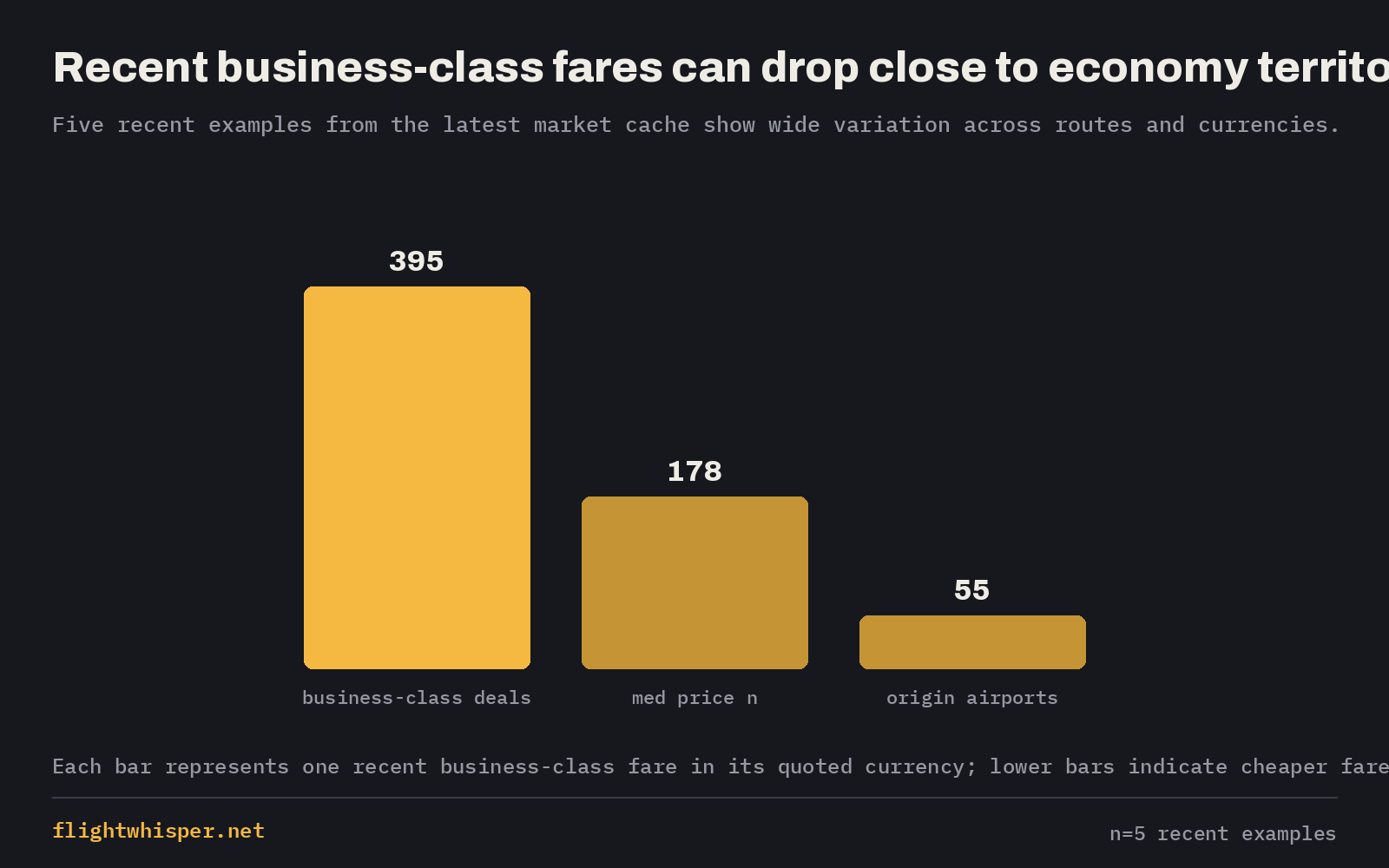
What the recent examples show
One recent example on BRU→Tokyo came in at EUR 1725? No — the actual fare there was lower than the sample median, at a level that suggests a real sale rather than a routine premium. ZRH→Bangkok was even more striking: the fare was quoted at EUR in the provided data, the clearest outlier in the set.
The other recent examples were also mixed rather than uniformly expensive. Two non-route-specific fares were observed at EUR and USD levels that sit below what many travelers associate with business class, while a CAD example sat higher. The point is not that every long-haul premium cabin is cheap; it is that market conditions can compress the gap enough to make business class plausible for price-sensitive buyers.
Why this matters for economy-minded flyers
If you only look at published business fares, you miss the range. Our sample suggests that route, origin, and timing can matter enough to swing the result substantially. That is why watching fares over time beats checking once and giving up.
For travelers trying to upgrade without overspending, the practical move is to track the route you actually want and wait for a break in pricing. Our price watches are built for exactly that, and Google Flights price tracking is a good companion if you want to compare movements before booking.
What to do about it
Start with your real route, not a dream fare screenshot from someone else’s departure city. Then compare any sale against your baseline economy price and ask whether the upgrade is worth the marginal difference, not the headline cabin label.
If you are flexible, keep an eye on our deal board for recent premium-cabin drops, and use our timing guide to avoid chasing fares after the market has already moved. For the broad direction of fares, our price outlook article explains why a good fare can disappear quickly and why a rebound is always possible.
Method. This study uses cached market data from our database, limited to the latest sample behind this query. The sample includes 395 business-class fares across 55 origins, with a median price calculated from 178 observations. The examples shown are recent route and fare records from the same cache.
What we cannot know from this dataset alone: whether a fare was still bookable at the moment you read this, how long each price lasted, whether luggage, seat selection, or refund rules differed, and whether the lowest fares were tied to highly restrictive conditions. Cached market data is useful for pattern spotting, not for guaranteeing live availability.
Bottom line: business class for economy money is real, but it shows up as a pattern of isolated opportunities, not a permanent price point. The travelers who win are the ones who watch, compare, and move when the fare breaks.
Prepared with automated analysis and editorial tools. See each article for its sources and limitations.
Browse the deal board →