Will flight prices go down? What our data can actually say

FlightWhisper's deal records cannot tell you whether the particular flight you are considering will get cheaper. They can describe when stored travel offers were first seen relative to a recorded departure date. Those are different questions.
That distinction matters when you are deciding whether to book or wait. A large collection of offers is not automatically a forecast, and a departure date in our database is not proof that someone purchased a ticket.
Correction: An earlier version called this sample “booked deals” and “verified deals.” Those descriptions overstated what the underlying query establishes. This revision describes stored records, not confirmed purchases or a collection of independently checked, currently bookable fares.
What we counted
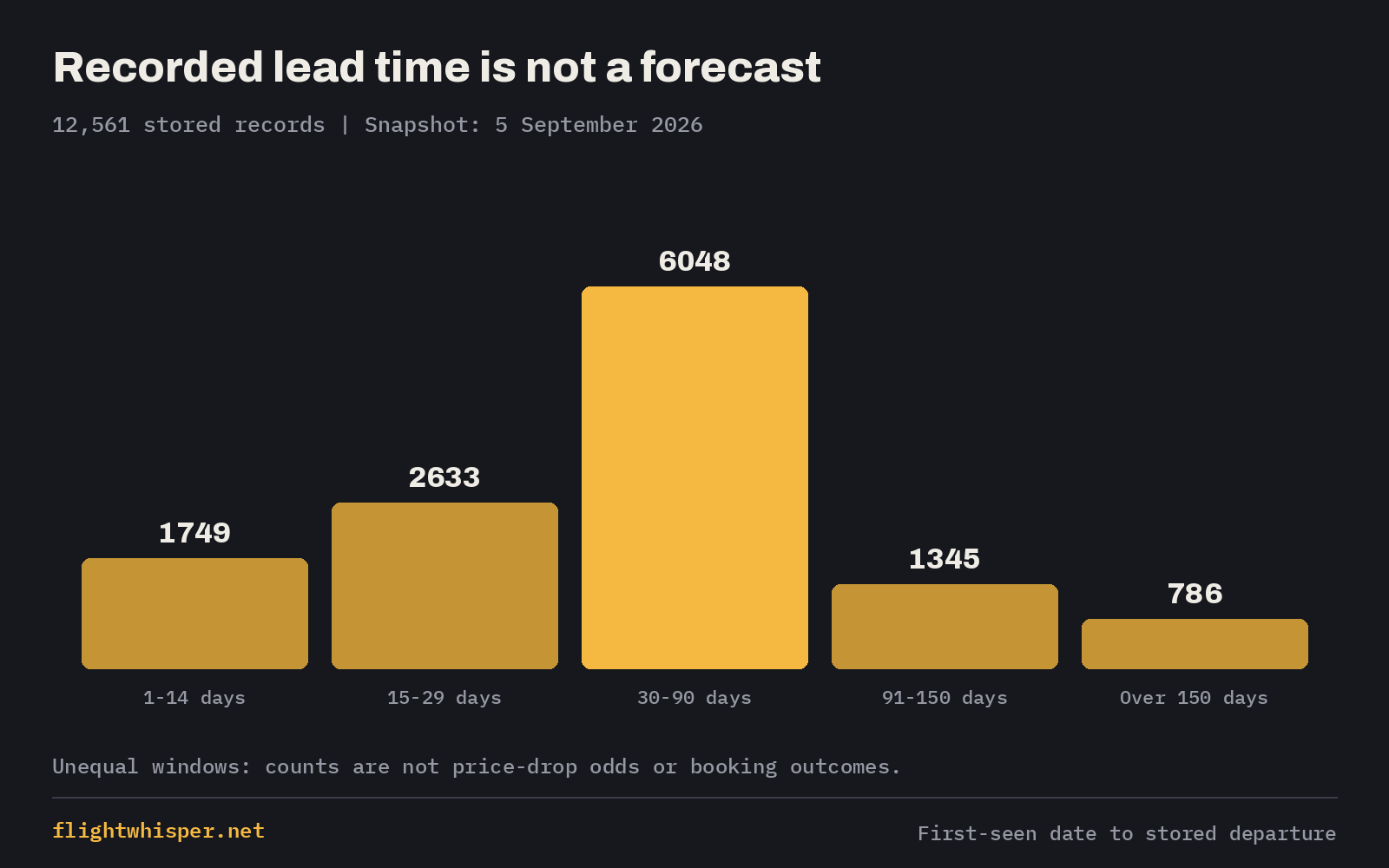
In a snapshot taken on 5 September 2026, the query selected 12,561 stored deal records with a resolved or approximate status and a recorded departure date later than the date we first saw the record. The median gap between those dates was 44 days.
This gap is a measure of recorded lead time—not when a traveler booked, not how long an offer remained available, and not how much its price later changed. A departure date may come from a source listing or a fare lookup. It is not necessarily the only date on which the original offer applied.
Here is the complete distribution across the five windows used for this summary:
| Gap from first-seen date to recorded departure | Stored records |
|---|---|
| 1–14 days | 1,749 |
| 15–29 days | 2,633 |
| 30–90 days | 6,048 |
| 91–150 days | 1,345 |
| More than 150 days | 786 |
The windows have different widths. A larger count in a longer window is not evidence that an individual traveler is more likely to find a price drop there. These counts also do not measure how often we searched every possible route or departure date.
Why these are not all verified fares
Of the selected records, 6,443 were marked resolved using dates already present in their source data. That processing step does not itself make a new fare-provider request. Another 2,108 carried an approximate status, rather than an exact price confirmation.
The selection also includes suppressed records, departures that have already passed and some records without both source airport codes. We have retained the query's original selection here to explain what it measures, not relabeled it as a cleaner or representative market sample.
Consequently, the total is not a count of tickets sold, unique travelers, independent price checks, currently available bargains or every offer in the market. Neither the total nor the median supports a universal best day to book.
What would answer the price-drop question?
To study whether waiting helps on a particular trip, we would need repeated, time-stamped prices for the same itinerary and comparable conditions: airports, departure and return dates, cabin, passengers, baggage, stops, currency and ticket rules. We would also need to account for offers that disappear, rather than retaining only the prices we can still find.
The lead-time counts above do not perform that comparison. Mixing different routes and departure dates can make a pattern look like a timing effect even when it reflects the trips we happened to collect. This snapshot should not be used to predict tomorrow's price or estimate the probability that your fare will fall.
A practical way to decide
Start with the trip you would actually buy. Write down acceptable airports, dates, connections and baggage needs, along with a total price you are comfortable paying. Compare alternatives against those same requirements rather than against the lowest headline price for a different trip.
If you choose to wait, treat a later check as new information—not a promise of a discount. Decide in advance what price or deadline would make you act. If you choose to book, confirm the final itinerary, total cost and change or cancellation terms with the seller before paying.
Ask FlightWhisper for travel ideas, then check the particular offer's details. You can also review alert options; a notification is a reason to inspect an offer, not a guarantee that its price or conditions still match your trip.
Method and limits
This is a dated snapshot of FlightWhisper's stored deal records, not a live availability check. Lead time is the stored departure date minus the calendar date the record was first seen. Only positive gaps enter this selection. The first window includes day 14; the last begins after day 150. All five counts sum to the stated total.
The sample combines collection sources and processing outcomes. We have not established that each record represents an independent offer, and we did not use booking transactions or passenger purchases. The figures describe this selected database snapshot only. They do not establish future price direction, market-wide timing advice or savings that a traveler can expect.
Prepared with automated analysis and editorial tools. See each article for its sources and limitations.
Ask FlightWhisper for a trip →