When to book flights: we measured it instead of repeating the advice

Every guide on this question gives you a number. Book six weeks ahead. Book six months ahead. Fly on a Tuesday. The numbers come from studies published by booking sites and travel search engines, and they get repeated so often that almost nobody checks whether they agree with each other.
We run a price radar, so we decided to measure it ourselves. This page is the result, and parts of it are still thin. We are publishing it early and updating it monthly with the raw counts visible, so you can watch the evidence get stronger instead of trusting a figure from a press release.
The short answer
On the routes we track, how far ahead you book matters far less than almost every article claims. Past about a month out, the price barely moves. There is a penalty for booking inside two weeks, and it is smaller than you would expect.
The published studies do not agree with each other
Before our own numbers, it is worth showing what the sources actually say, because they are quoted as if they were one settled answer. They are not.
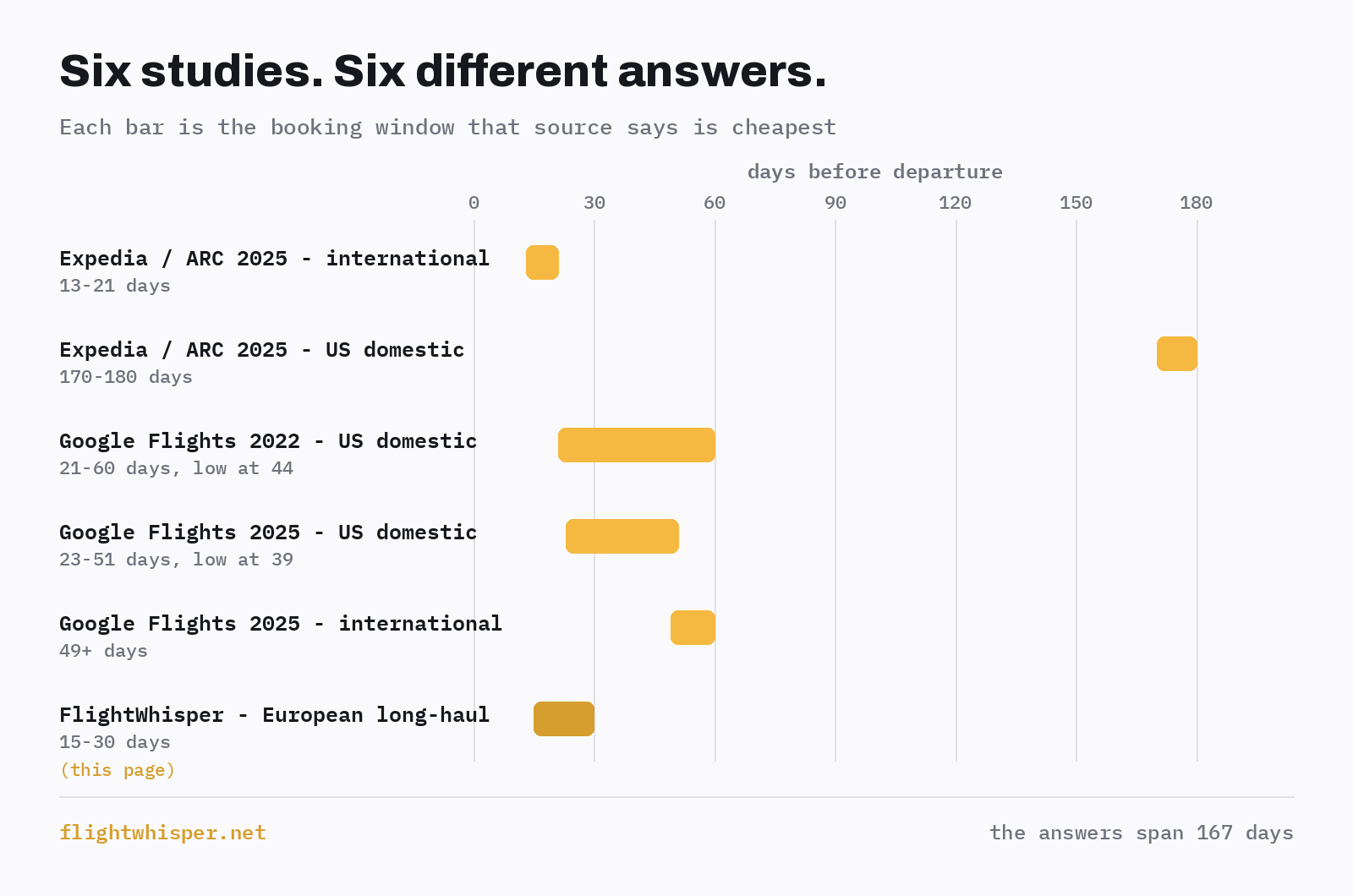
Expedia's 2025 Air Hacks Report, built with the Airlines Reporting Corporation, puts the international sweet spot at 13 to 21 days out and says booking too far ahead costs you money. The same report puts US domestic at 170 to 180 days. That is one study recommending three weeks and six months depending on the flight.
Google Flights' analysis of five years of fare data lands somewhere else again: US domestic fares bottom out 44 days out, with a low band of 21 to 60 days. Their 2025 update, on four years of data, moved that to 39 days domestic and 49 days or more international. Google also found that the day of the week you book changes the price by only 1.9%, which quietly kills the Tuesday rule that half the internet still repeats.
Note that two of those bars are both Google, three years apart, and they do not agree with each other either. These are large, competent studies. The reason they disagree is that they measure different markets in different years with different methods, and each headline then gets repeated stripped of that context. So the useful question is not "which one is right", it is "what happens on the routes I actually fly".
What we measured ourselves
The table below is the important one, and it needs a sentence of explanation. Each fare is compared against the median fare for that same route and that same departure month. That removes the two things which ruin most analyses of this question: expensive routes dragging the average around, and season being mistaken for lead time.
| Booked | vs typical | difference | fares |
|---|---|---|---|
| 0-7 days | 103% | +3% dearer | 193 |
| 8-14 days | 101% | +1% dearer | 203 |
| 15-30 days | 99% | 1% cheaper | 457 |
| 31-60 days | 100% | no difference | 762 |
| 61-90 days | 99% | 1% cheaper | 615 |
| 91-120 days | 100% | no difference | 502 |
| 120+ days | 100% | no difference | 428 |
Read 100% as "the fare matched what that route normally costs for that month". We have not drawn this as a bar chart on purpose: the differences are so small that any bar scaled to make them visible would exaggerate them.
The entire spread is 4 percentage points. Booking in the last week is the dearest window we measure. The cheapest is 15-30 days out. Everything from a month out to seven months out is flat, within the noise of our sample.
Why this contradicts the usual advice
The familiar version says prices climb steeply as departure approaches, so booking three months early saves real money. Our data does not show that. It shows a small last-minute penalty and then a plateau.
We think the difference is what gets measured. Average all fares by lead time and you will find that fares booked six months out are more expensive, because six months out is what people book for peak season. Sample in August and every departure 121 to 180 days away is December. December is expensive. That is not a booking-window effect. That is Christmas.
Here is that seasonal effect in our own data, kept deliberately separate:
| Departure month | Median fare | Sample |
|---|---|---|
| 2026-08 | EUR 549 | 313 fares, 22 routes |
| 2026-09 | EUR 445 | 610 fares, 22 routes |
| 2026-10 | EUR 482 | 750 fares, 22 routes |
| 2026-11 | EUR 469 | 630 fares, 21 routes |
| 2026-12 | EUR 578 | 548 fares, 22 routes |
| 2027-01 | EUR 471 | 61 fares, 17 routes |
| 2027-02 | EUR 611 | 197 fares, 18 routes |
| 2027-03 | EUR 584 | 51 fares, 15 routes |
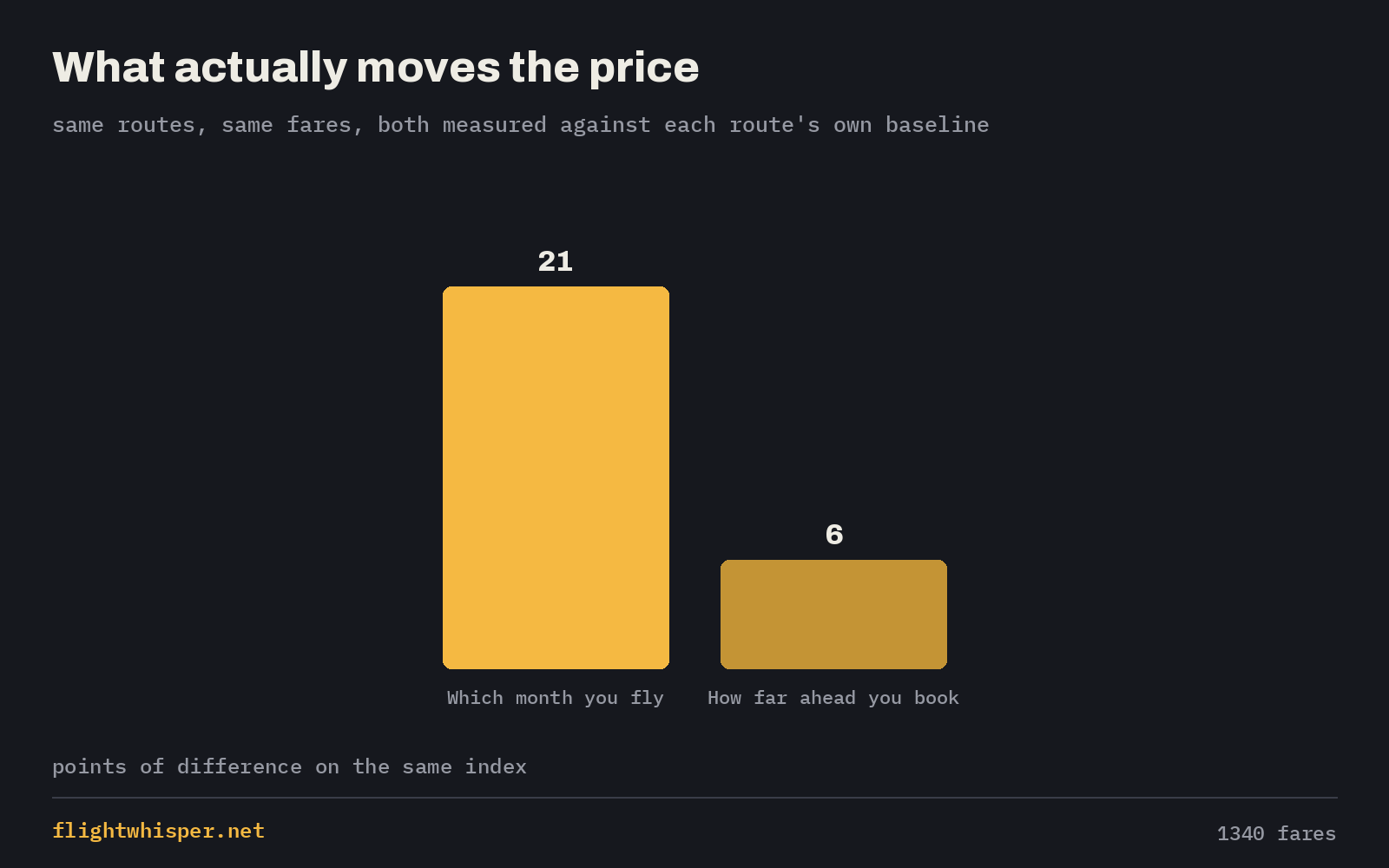
The month you fly moves the price far more than the day you book. Comparing each route against its own baseline, so that a month sampling fewer routes cannot distort the picture, the gap between the dearest and cheapest month is 24 points. The entire booking-window effect is 4. No booking strategy recovers a gap that size, which is why the flexible-dates advice below matters more than any calendar rule. Our deal board is built around that: it shows what is cheap right now rather than asking you to guess a date.
If you have a route in mind, a price watch does the waiting for you and tells you when a fare drops below its usual level.
What we cannot tell you yet
Being specific about the gaps, because a page like this is only useful if you know where it is thin.
- Whether the price of a specific flight rises as its date approaches. That needs the same departure date watched across months, and we are 5 samples in. Ask us in the spring.
- Day-of-week effects. Every guide claims Tuesday; Google found only 1.9% in it, and Expedia says Sunday. We do not yet have the density to add our own answer, so we are not going to pick a side.
- Seasonality year over year. Needs a full year of history. We will have it.
- Whether this holds beyond our 22 routes. The panel is European origins to long-haul destinations, plus some intra-Europe. It is not a global claim.
What to actually do
- Do not panic-book months early to beat a price rise that is not coming. Past a month out, you have time.
- Do avoid the last two weeks where you can. That is where the real penalty sits, and it is the part of the standard advice our data agrees with.
- Move your dates before you move your booking date. Shifting a trip out of a peak month saved more on our routes than any booking-window tactic.
- Watch the route instead of guessing. Fares on one route swing far more than the booking-window average does, and that swing is where the savings actually are.
That last point is what we built FlightWhisper for. We post fares that are unusually cheap for their route, and you can set a watch on a route and be told when one appears. It is free, and it is more reliable than any calendar rule.
Sources
- Expedia 2025 Air Hacks Report (with Airlines Reporting Corporation) - booking windows, day of booking, day of travel.
- Google Flights: how to find the best deal on your next flight - five years of fare data, the 1.9% day-of-booking finding, the 44-day domestic low.
- Google Flights 2025 holiday travel insights - the updated 39-day domestic and 49-day international figures.
- US Bureau of Transportation Statistics - quarterly average domestic itinerary fares, for checking whether fares are broadly rising or falling.
Prepared with automated analysis and editorial tools. See each article for its sources and limitations.
Ask FlightWhisper for a trip →