How Far in Advance to Book Flights? 44 Days
The question is simple: how far in advance should you actually book? Our verified deal data says the median lead time is 44 days, but the bigger answer is more useful than a single number: the cheapest booking window is 15-30 days, and the fare gap between best and worst windows is only 5%.
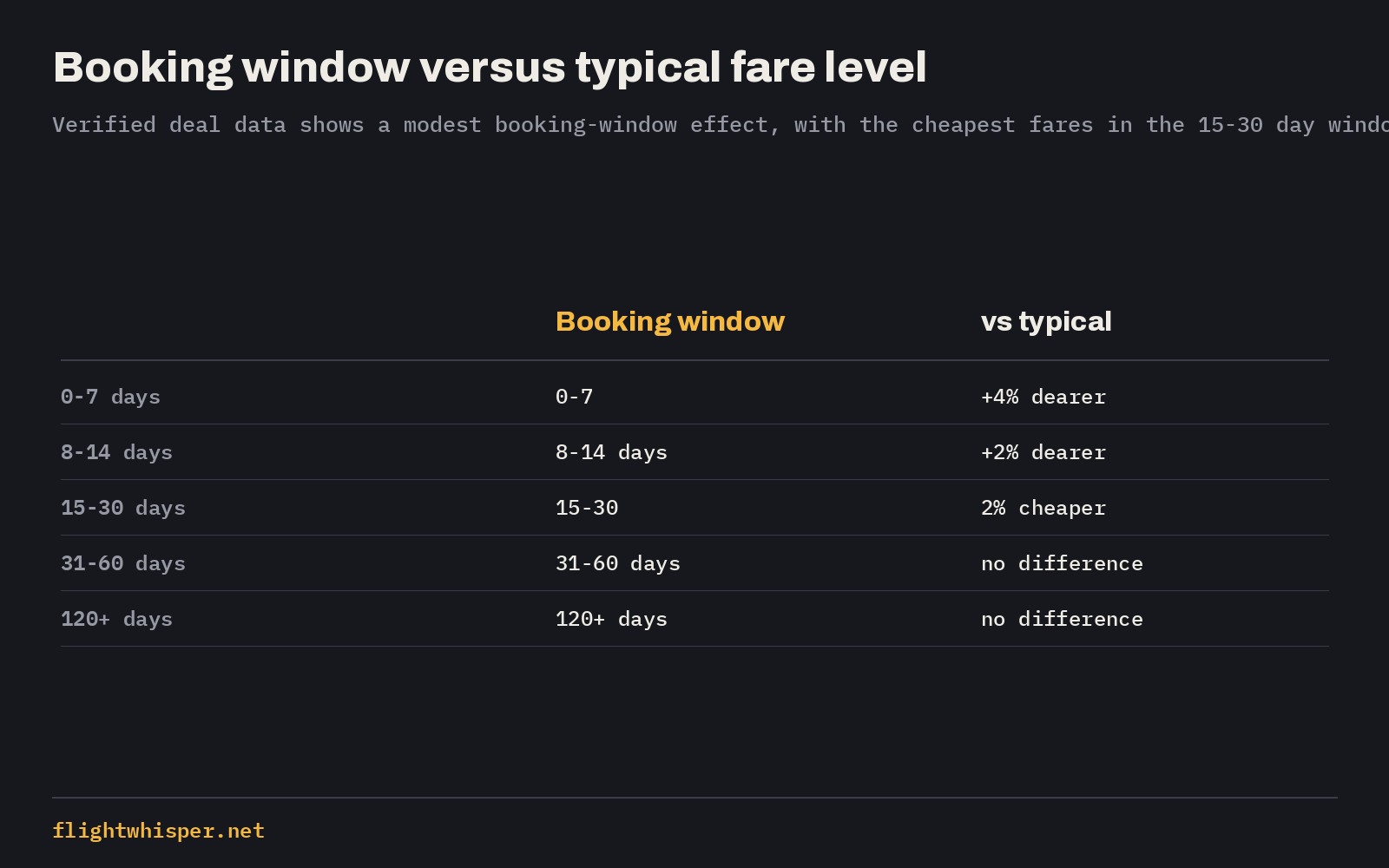
That means there is no magic far-ahead rule that always wins. In this dataset, booking very early does not create a consistent discount, and waiting until the last week is the clearest way to pay more. The worst window is the 0-7 day window, where fares run 3% above typical, while the cheapest is the 15-30 day window, where fares run 2% below the typical level. The difference between those two is only 5%, so timing your booking matters, but not nearly as much as the month you fly.
What the booking window actually does
Across 12823 fares, the middle of the market sits around one and a half months out. The strongest signal is not an early-booking jackpot; it is the late-booking penalty. The 1795 fares booked within 14 days are concentrated in the short window where prices are highest, while the 6163 fares booked 30-90 days out cover the broad middle where pricing is mostly flat.
That flatness matters. In the 31-60, 61-90, 91-120, and 120+ day windows, fares all sit at typical levels. Only the 15-30 window dips below that baseline, and even then only by 2%. If you are trying to choose between booking now and waiting a little, this data does not support the idea that booking far earlier is automatically smarter. For live monitoring, our price watches are usually the better tool than guessing the exact day to buy.
Month beats booking window
If you want the part of the trip that moves prices most, it is the month of departure. That factor is larger than the booking window itself: season moves the fare more than booking window (24 points against 5).
In the month-level view, the median fare is lowest in November 2026 and highest in August 2026. Across the six departure months we tracked, medians range from the high four hundreds into the low six hundreds, which is a much wider swing than the booking-window effect. If you are choosing where to put your effort, it is usually better to compare dates on our deal board first, then think about timing the purchase second.
So how far ahead should you book?
For the verified deals in this study, the honest answer is: book roughly in the middle, not at the extremes. The median lead time is 44 days, and the cheapest observed window is 15-30 days. Booking earlier than that does not reliably improve fares, and booking inside the final week is the clearest way to overpay.
There are limits. We can see what happened in the cached market data we sampled, but we cannot know the true minimum fare on every route, or whether a deal disappeared before it was captured. The point is not that every route obeys the same rule. It is that the broad pattern is stable enough to act on: avoid the last-minute window, do not assume extra months of lead time guarantee a win, and lean on alerts if your dates are flexible.
Method. This study uses 12823 verified fares across 22 routes, spanning 27 days of cached market data. The lead-time curve includes 2567 observations, with a shortest lead time of 0 days and a longest of 206 days. We report medians and window-level fare levels from that cached market snapshot. What we cannot know: the unobserved price path between captures, the true lowest fare that may have flashed briefly, and how a fare might change after our last sample day.
What to do with it. If your trip is already in the market, search early enough to avoid the final week, but do not assume a huge discount just because you wait. If you have a flexible departure month, treat that as the bigger lever and use price tracking on Google Flights or our when-to-book guide to decide whether to buy now or keep watching.
Prepared with automated analysis and editorial tools. See each article for its sources and limitations.
Ask FlightWhisper for a trip →