How Flight Deal Alerts Reach Your Inbox
A flight deal alert is not magic and it is not a promise. It is a fast signal that a fare worth checking has been detected, packaged, and sent to you before the market moves again. The useful question is not whether alerts are perfect. It is how to read them well enough to act when they are genuinely strong.
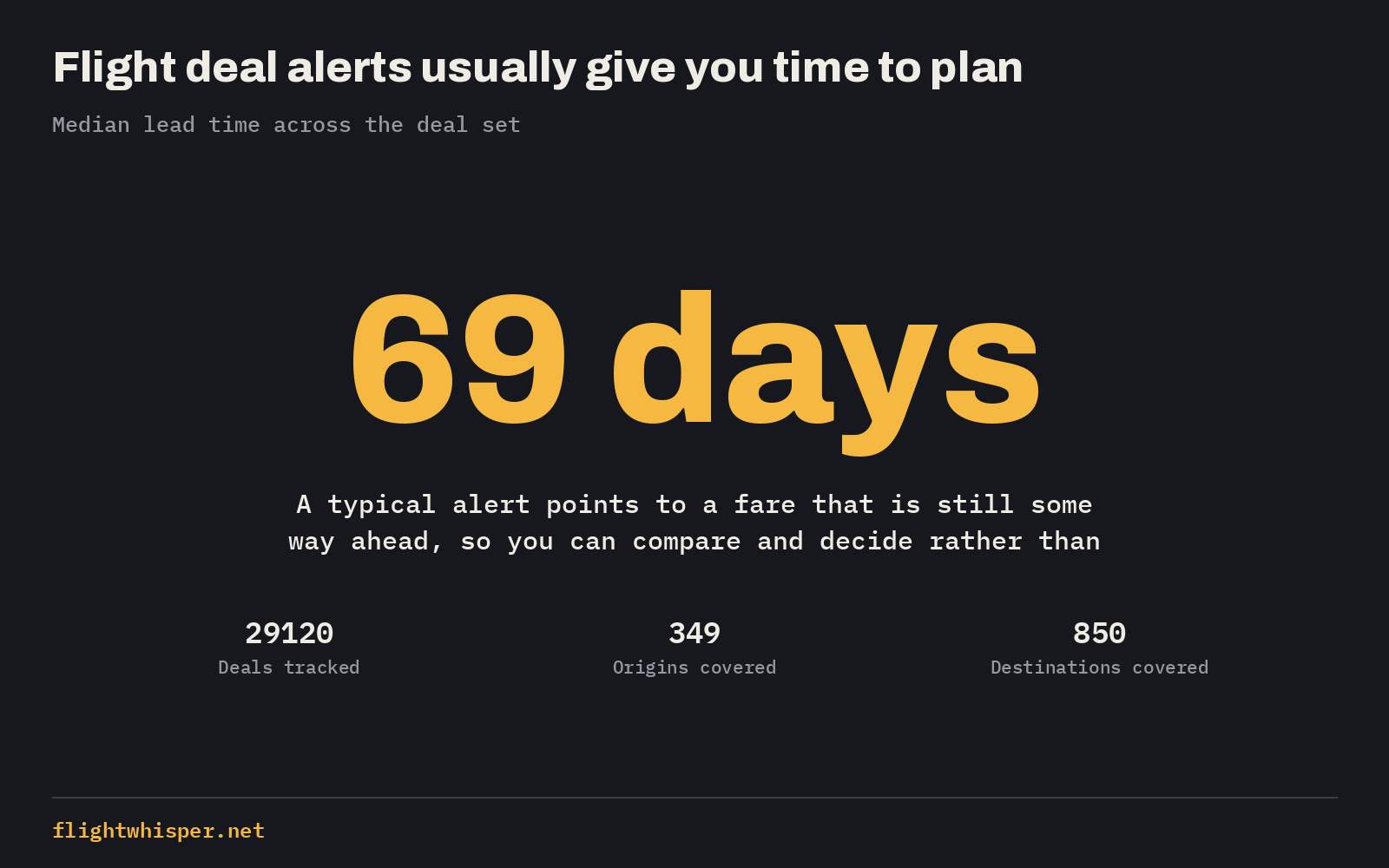
Our radar has logged 29120 deals across 349 origins and 850 destinations, with 14459 resolved examples in the dataset. The median lead time is 69 days, which is a practical clue: many alerts point to trips you are still planning, not departures tomorrow. That makes them most useful when you can move quickly on dates, airports, or cabin class.
What a flight deal alert actually is
A flight deal alert is a notice that a fare has crossed a threshold worth surfacing. In practice, that threshold may be set by a route, a price band, a percentage drop, or a comparison against recent market behavior. The point is to reduce noise. You should expect some alerts to be excellent, some to be merely interesting, and some to be gone by the time you open them.
That is why alerts work best as a filter, not a guarantee. They help you see unusual fares without refreshing search results all day. If you want a broader view of what is on sale right now, start with our deal board and then turn on alerts for the routes you actually care about.
How the radar ping becomes an email
Under the hood, an alert usually follows a simple path. First, a price is found in the market data. Then it is checked against the alert logic. If it qualifies, the system packages the route, price, and timing into a message. That message then lands in your inbox, where your job is to decide whether the fare still fits your trip.
This is why timing matters. Flight prices can move between detection and delivery, especially on busy routes. An alert is a snapshot, not a reservation. Treat it as the first step in a short decision process, not the last step.
When you are deciding whether to follow through, it helps to compare the alert with broader context. If you are unsure about timing, our guide on when to book flights is a better companion than guessing from one email alone. If you want a second layer of monitoring, pair alerts with price watches so you can track the fare after the first ping.
How to act when an alert arrives
Open the alert quickly, but do not book blindly. Check the route, dates, baggage rules, and total cost. A fare that looks cheap on the surface can change once bags, seat selection, or schedule constraints are added. The alert should start your review, not end it.
Use these practical steps:
- Confirm the exact airports and dates before you decide anything.
- Compare the fare with the rest of the market, not just with your memory.
- Check whether the trip still works if the dates shift by a day or two.
- Move faster when the route is flexible and the price is clearly below what you expected.
- Keep the alert if you are watching a destination over time, even after one missed opportunity.
Some alerts will be for routes you can actually use; others will simply teach you what that market looks like. For example, our dataset includes examples such as BCN→New York at EUR 245 and BOS→Bergen at USD 431. Those are useful not because every traveler can book them, but because they show how specific and route-dependent a good alert can be.
Realistic caveats
Flight deal alerts are only as good as the underlying market data and the rules that decide what counts as a deal. They can miss niche inventory, surface fares that are already fading, or highlight trips that require dates you cannot use. They can also overfit to what looks cheap today rather than what is convenient for your schedule.
That is normal. A strong alert system saves time by narrowing the search space. It does not eliminate judgment. If you want more control, set alerts for routes you would actually take, use the board to sanity-check the alert, and keep an eye on how much time you really have before departure. The median lead time in our data suggests these alerts are often most helpful when you are planning ahead, not booking at the last minute.
Methodology and limits. This guide uses cached market data from our monthly recomputation window. Sample size: 29120 deals, with 14459 resolved examples across 349 origins and 850 destinations. We also use the median lead time of 69 days and the median teaser tax share of 14%. We can see how deals appeared in the data and what was resolved, but we cannot know every traveler’s exact baggage, schedule, or booking outcome, and we cannot guarantee that a fare still exists after the alert is sent.
The practical takeaway is simple: use alerts to catch the market early, then verify fast. If the fare still fits after you check the details, book with confidence. If not, keep the alert on and wait for the next ping.
Prepared with automated analysis and editorial tools. See each article for its sources and limitations.
Browse the deal board →