Error fares: what they are, why airlines honor them, how to catch one
Everyone asks the same thing: what counts as an error fare, and do airlines really let you keep it? The short answer is yes, sometimes. But the longer answer matters more: error fares are pricing mistakes, not a travel strategy. They can disappear fast, get canceled, or be honored with conditions you do not control.
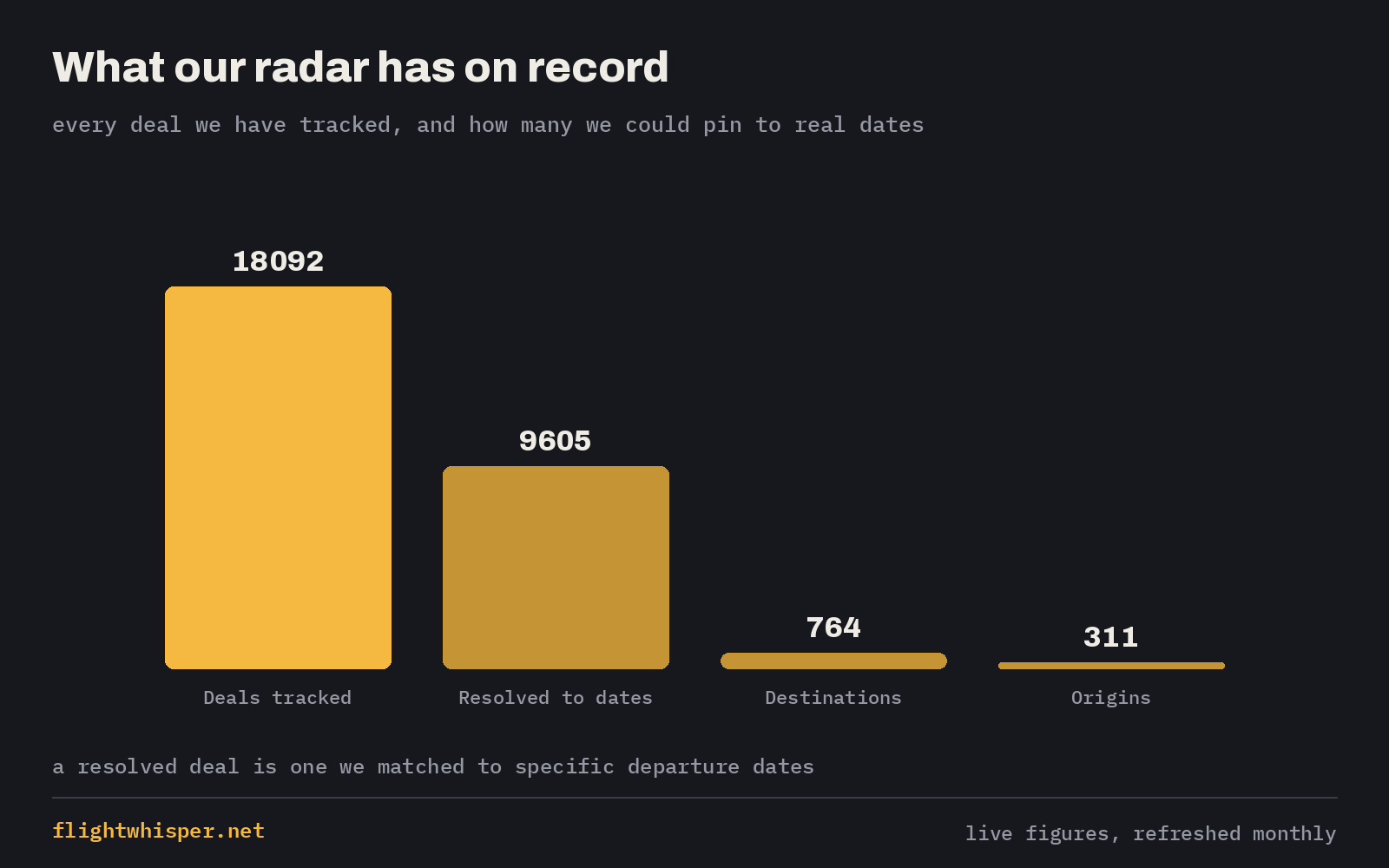
FlightWhisper’s radar keeps a record of how these deals move through the market. In our dataset, we have 30527 tracked deals across 355 origins and 856 destinations, with 15011 already resolved. The median lead time is 69 days, which is a reminder that the best chance to act is usually before a mistake becomes common knowledge. Live finds sit on our deal board as we verify them.
What an error fare is
An error fare is a ticket priced incorrectly. The mistake can come from a technical glitch, a currency conversion problem, a fuel surcharge that was dropped, a fare rule filed wrong, or a simple human typo. The important part is not the cause but the result: the price is meaningfully below what the airline intended to sell.
That does not mean every unusually cheap ticket is an error fare. Sometimes a low price is just a promotion, a new route launch, a competitive response, or a basic fare sale with restrictive rules. Real error fares usually look out of pattern: a long-haul premium cabin at an implausible price, a complex itinerary cheaper than a domestic hop, or a fare that undercuts the rest of the market by a wide margin.
Why airlines sometimes honor them
Airlines honor error fares for a few reasons. The simplest is operational: once a ticket is issued, changing it costs time, staff attention, and customer trust. On some bookings, especially if the airline does not detect the problem immediately, the cheapest path is to let the ticket stand.
There is also a reputational angle. Airlines know that chasing every mistake creates backlash, while honoring some errors can look fair and orderly. That said, honor is never guaranteed. Depending on the fare rules, the airline’s terms of carriage, the issuing channel, and how quickly the error is caught, the ticket can be canceled, reissued at a corrected price, or left untouched.
In other words, the real question is not whether airlines “allow” error fares in principle. It is whether they decide, case by case, that honoring one is better than fighting it.
How to catch one
The practical part is speed, pattern recognition, and restraint. Error fares are often visible for only a short period, and by the time they show up in a crowded feed, the easy win may already be gone.
- Watch routes you already want. Error fares are more useful when they match a trip you would actually take. Chasing random bargains is how people book the wrong trip with the wrong rules.
- Set alerts before you need them. Set a price watch so you are not starting from zero when a fare drops.
- Check the market baseline. If one fare is far below everything else, compare dates, cabins, and airports before you assume it is valid.
- Move quickly, but verify once. Booking fast matters. So does confirming that the route, dates, baggage rules, and currency all make sense.
- Keep your expectations modest. Many obvious mistakes are fixed fast, and some are canceled later. The best win is a real trip you would still want if the airline reviews it.
When an odd fare appears, the decision tree is simple: search the route, compare the surrounding dates, and book only if the total price and rules still make sense after you remove the excitement factor. Our deal board can help you see whether a deal is an isolated outlier or part of a wider shift.
If you want to be told when a specific route drops, a price watch is the reliable version of refreshing a search.
What to do after you book
Once a suspiciously cheap ticket is ticketed, do not make nonrefundable plans around it immediately. Wait for the booking to settle, save the confirmation, and keep an eye on the reservation. If the airline honors it, you can treat it as a real trip. If it does not, you want to know early enough to change plans without extra damage.
It also helps to understand the full economics of a deal. Taxes, fees, baggage, seat selection, and schedule changes can turn a headline price into something less impressive. If you want a plain-language breakdown of that tradeoff, see /blog/what-flight-deals-really-cost.
FlightWhisper’s data supports a simple rule: there are real opportunities, but they are sparse, uneven, and time-sensitive. The median lead time is 69 days, not a promise that every fare sits around that long, but a useful signal that being early matters more than being lucky. The best error-fare hunters are not the ones refreshing endlessly; they are the ones watching a few routes, recognizing when a price is genuinely wrong, and acting with discipline.
We reviewed 30527 cached market records spanning 355 origins and 856 destinations, with 15011 deals resolved as of the latest monthly recomputation. The market data are cached, so they reflect observed listings rather than live inventory. We can see quoted prices, route coverage, and resolution status, but we cannot know the airline’s internal intent, whether each fare was a true filing error, or how often unobserved cancellations later occurred outside the dataset.
Prepared with automated analysis and editorial tools. See each article for its sources and limitations.
Ask FlightWhisper for a trip →